Ketamine Therapy for Treatment-Resistant Depression


A Rapid, Evidence-Based Option for Treatment-Resistant Depression
Ketamine infusion therapy is a sub-anesthetic-dose intravenous protocol that produces measurable antidepressant response within 24 to 72 hours for the majority of patients with treatment-resistant depression, PTSD, and suicidal depression. It is offered as an augmentation to ongoing psychiatric care, not a replacement for it.
Who ketamine therapy is designed for
The evidence base for ketamine is strongest in treatment-resistant depression — defined as inadequate response to at least two adequate trials of antidepressants from different classes. Ketamine also has FDA-recognized indications (through the esketamine formulation) for depression with acute suicidality, and a growing evidence base for PTSD, OCD refractory to SSRIs, and alcohol and cocaine use disorders as an adjunct to structured therapy.
At RECO Health, we accept referrals for the full range of these indications, but we screen carefully — approximately one in seven referred candidates is redirected to a different treatment pathway because ketamine is not appropriate for their clinical picture.
What sets ketamine apart from SSRIs
Traditional antidepressants target the monoamine system (serotonin, norepinephrine, dopamine) and typically require four to six weeks of daily dosing before clinical response emerges. Ketamine works through a fundamentally different mechanism: it is a non-competitive NMDA-receptor antagonist that acutely modulates glutamate signaling and rapidly increases synaptic plasticity through BDNF-mediated pathways.
The clinical result is a very different response curve — hours to days rather than weeks — with the trade-off that individual infusion effects wane, requiring repeated dosing during induction and periodic maintenance. This is why ketamine is delivered as a series, not as a single infusion.
The Neuroscience of Ketamine's Antidepressant Effect
The mechanism of ketamine's antidepressant action has been an active area of neuroscience research since the pivotal Zarate et al. 2006 NIMH trial that documented rapid antidepressant response after a single 0.5 mg/kg IV infusion in patients with treatment-resistant major depression. The current best-supported model identifies four converging pathways:
- NMDA-receptor antagonism on GABAergic interneurons disinhibits pyramidal neurons in prefrontal cortex, producing a transient surge of glutamate release.
- AMPA-receptor activation in the wake of that glutamate surge triggers rapid intracellular signaling through the mTOR pathway.
- BDNF release and TrkB activation drive new dendritic spine formation on prefrontal pyramidal neurons within hours — the structural correlate of antidepressant response.
- Restoration of functional connectivity in default-mode and salience networks, measurable on functional MRI, appears to underlie the clinical improvement in rumination and cognitive rigidity.
The pragmatic implication for patients: ketamine is not "the same as an SSRI, but faster." It is a mechanistically different treatment with a different response and maintenance profile. Understanding this is important for setting realistic expectations, particularly the reality that a single infusion is not a cure and that maintenance dosing is nearly always required.
Clinical Indications We Treat with Ketamine
Treatment-Resistant Depression
Patients with unipolar major depression who have not responded to at least two adequate antidepressant trials from different classes. Baseline PHQ-9 and MADRS scores are collected before infusion 1 and tracked weekly through induction and maintenance to document response.
Depression with Acute Suicidality
Ketamine has documented rapid anti-suicidal effects that appear to be partially independent of its antidepressant effect. This makes it particularly relevant for patients with recent suicide attempts, active suicidal ideation, or acute post-discharge windows where SSRIs have not yet taken effect.
PTSD Refractory to First-Line Care
For patients who have not adequately responded to trauma-focused psychotherapy (prolonged exposure, CPT, EMDR) with or without SSRI augmentation, ketamine has emerging RCT support as an adjunct that appears to open a neuroplastic window for trauma processing.
Co-Occurring Substance Use Disorder
Growing RCT evidence for ketamine in alcohol use disorder (Dakwar et al. 2020) and cocaine use disorder (Dakwar 2019) as an adjunct to motivational-enhancement therapy. At RECO Health, integrated ketamine + addiction therapy is a core specialty because most patients in TRD have concurrent substance use histories.
OCD Refractory to SSRIs
For OCD that has failed high-dose SSRI trials plus adequate exposure-and-response-prevention therapy, ketamine has produced meaningful acute reductions in obsessional intensity in small trials. Effects are typically shorter than in depression and require frequent maintenance.
Bipolar Depression (Selected Cases)
For bipolar II or well-controlled bipolar I patients who are in a depressive episode refractory to mood-stabilizer optimization, ketamine may be used cautiously with concurrent mood-stabilizer coverage. Not appropriate for active mania or mixed states.
Your Six-Infusion Induction Series, Step by Step
Consultation and medical clearance (day 1)
A 60-minute intake with our psychiatric provider covers current symptoms, treatment history, medication list, medical history (especially cardiovascular, hepatic, and psychiatric), and baseline PHQ-9/MADRS/GAD-7 scoring. We review the risks, benefits, alternatives, and cost, obtain informed consent, and confirm you have a driver for each infusion day. Baseline labs (CMP, TSH) are ordered if not recent.
Infusion day arrival and monitoring setup
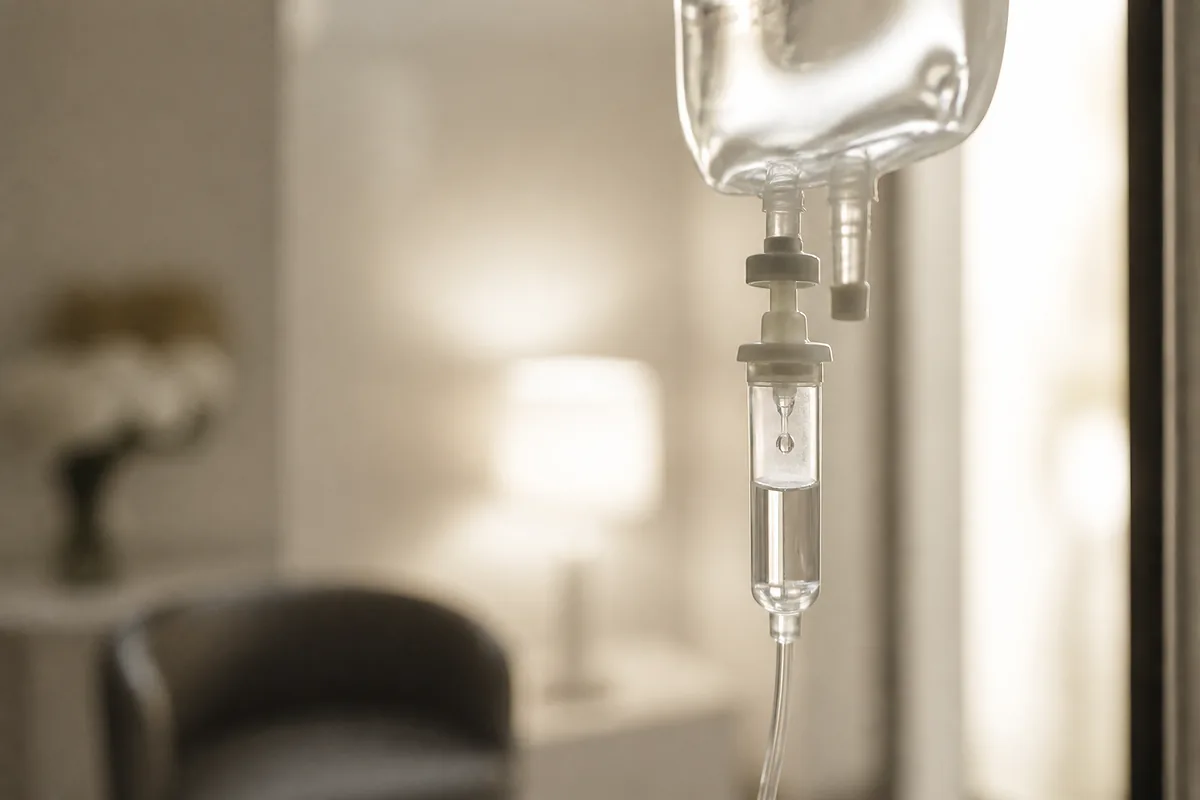
You arrive in loose comfortable clothing having not eaten in the past 4 hours. A licensed nurse takes baseline vitals, places a peripheral IV, and attaches continuous pulse oximetry and a blood-pressure cuff cycling every 10 minutes. You settle into a private, dimly-lit room with a reclining chair, weighted blanket, and eye mask if preferred.
The infusion (40 minutes)
Ketamine is infused at 0.5 mg per kg of ideal body weight over 40 minutes via a programmable syringe pump. Most patients experience dissociative effects — floating sensation, altered time perception, mild visual changes — that build over the first 15 minutes, peak around minute 20 to 25, and fade over the last 10 minutes. Occasional nausea is managed with ondansetron; transient blood-pressure elevation is monitored and rarely requires intervention.
Recovery and discharge (30 minutes)
The infusion ends and dissociation resolves rapidly. Vitals are monitored for 30 minutes; patients are cleared for discharge when oriented, able to walk steadily, and vitals have returned to baseline. Total in-facility time is approximately 90 minutes. You cannot drive for the remainder of the day and should avoid signing legal documents or making major decisions until the following morning.
Infusion series and outcome tracking
The induction series runs six infusions over two to three weeks — typically Monday/Wednesday/Friday for two weeks. PHQ-9 and MADRS are re-scored before each infusion so response is measured, not guessed. Approximately 70% of TRD patients meet response criteria (≥50% symptom reduction) by infusion 6.
Maintenance plan and transition
After the induction series, we design a maintenance plan based on your individual response curve: booster infusions every four to eight weeks, transition to an oral maintenance regimen (SSRI/SNRI plus lithium or antipsychotic augmentation), or referral to Spravato with insurance coverage. Ongoing psychotherapy is strongly encouraged — the neuroplastic window opened by ketamine appears to enhance therapy uptake in the days after each infusion.
Safety Profile, Contraindications, and Side Effects
Contraindications we screen for
Ketamine is contraindicated in patients with uncontrolled hypertension (systolic >160 or diastolic >100 at baseline), active psychosis or primary psychotic disorder, history of increased intracranial pressure or intracranial mass, untreated hyperthyroidism, and pregnancy. Relative contraindications include severe cardiovascular disease, severe hepatic impairment, active substance use of dissociatives, and unstable bipolar I disorder.
Common side effects during infusion
Transient dissociation, mild visual distortion, altered time perception, and floating sensation are expected effects during infusion, not adverse events. Nausea occurs in about 20% of infusions and is prevented with 4 mg ondansetron. Transient blood-pressure elevation is common; sustained elevation requiring intervention is rare. Post-infusion drowsiness and mild fatigue are the most common carry-over effects.
Rare adverse events
Emergence phenomena (vivid dysphoric dissociation persisting beyond the infusion) occur in fewer than 1% of infusions and are managed with midazolam. Interstitial cystitis, which is well-documented with chronic high-dose recreational ketamine use, has not been reported at sub-anesthetic antidepressant dosing regimens in clinical settings. Long-term data are still accumulating.
Post-infusion self-care
No driving, machinery operation, or signing legal documents for the rest of the day. Eat lightly. Stay hydrated. Journaling within 24 hours of infusion appears to consolidate therapeutic insights. Notify the psychiatric team of any prolonged mood shifts, unusual anxiety, or emerging psychotic symptoms; the on-call line is answered 24/7 by clinical staff.
What You Will Pay, and What Insurance Covers
As of 2026, racemic IV ketamine for depression remains off-label. Most commercial plans do not cover the infusions themselves. However, Spravato (intranasal esketamine) is FDA-approved for treatment-resistant depression and depression with suicidality, and is covered by Aetna, Cigna, UnitedHealthcare, Humana, Florida Blue, and most other commercial and Medicare plans when clinical criteria are met.
Our admissions and billing team runs a complete benefits check within 24 hours of your first call, tells you honestly what will be covered and what is out-of-pocket for both the IV and Spravato pathway, and helps you decide which route matches your response history, insurance, and scheduling. Payment plans and third-party medical financing are available for the IV pathway.
Frequently Asked Questions
Ketamine acts on the glutamate system and produces measurable antidepressant effects within hours to days of the first infusion, compared to the four-to-six-week onset typical of SSRIs. In the landmark studies by Zarate and colleagues at NIH, 71% of patients with treatment-resistant depression met response criteria at 24 hours after a single infusion, though the effect wanes without repeated dosing. This is why standard clinical practice uses a six-infusion induction over two to three weeks followed by individualized maintenance based on symptom trajectory.
Clinically administered intravenous ketamine at sub-anesthetic antidepressant doses has a very low addiction liability compared to recreational ketamine use. In fact, ketamine has been studied as a treatment for alcohol use disorder and cocaine use disorder with promising early results. At RECO Health, ketamine is delivered by anesthesia-trained clinicians in a controlled setting, not prescribed as a take-home medication. Patients in early recovery are screened carefully, and infusions are integrated with ongoing addiction therapy rather than replacing it.
Each infusion runs approximately 40 minutes in a private, dimmed treatment room with a reclining chair. A licensed nurse places an IV, attaches continuous pulse oximetry and blood pressure monitoring, and starts the ketamine infusion at 0.5 mg per kg of ideal body weight. Most patients experience mild dissociation — a sense of floating or altered time perception — that peaks around minute 20 and resolves within 20 to 30 minutes of infusion end. A monitored recovery period follows, and patients are cleared for discharge with a driver approximately 90 minutes after arrival.
IV racemic ketamine for depression remains an off-label use of an FDA-approved anesthetic, so most commercial insurance plans do not cover the infusions themselves as of 2026. Some plans reimburse a portion under out-of-network mental-health benefits, and Spravato — the intranasal esketamine that is FDA-approved for treatment-resistant depression — is covered by most plans when medical necessity criteria are met. Our admissions team runs a full benefits check within 24 hours of your call and lays out the covered, out-of-pocket, and financing options so there are no surprises.
IV ketamine is the racemic mixture of R- and S-ketamine given intravenously; Spravato is the S-enantiomer (esketamine) given as a nasal spray. IV ketamine is off-label but has a larger, longer-standing evidence base and typically produces a faster and more complete antidepressant response. Spravato is FDA-approved for treatment-resistant depression and depression with suicidality, is REMS-controlled, and is covered by most insurance — but requires twice-weekly visits during induction and two hours of in-office monitoring per dose. RECO Health offers both and helps patients choose based on response history, insurance coverage, and scheduling.
Response to a six-infusion induction typically lasts one to three months without additional treatment; some patients relapse within days, others stay well for over a year. Maintenance strategy is individualized: many patients receive a booster infusion every four to eight weeks based on symptom trajectory, others transition to an oral maintenance strategy with an SSRI/SNRI plus low-dose lithium or an atypical antipsychotic augmentation. Our psychiatric team tracks PHQ-9 and MADRS scores weekly and adjusts the maintenance schedule to the individual response curve rather than a fixed protocol.
Absolute contraindications include uncontrolled hypertension, active psychosis, primary psychotic disorders, history of increased intracranial pressure or intracranial mass, untreated hyperthyroidism, and pregnancy. Relative contraindications include severe cardiovascular disease, severe hepatic impairment, and active substance use of ketamine or other dissociatives. We screen every candidate with a full psychiatric evaluation, medical history review, and baseline vitals; approximately one in seven referred patients is redirected to an alternate treatment because ketamine is not appropriate.
Yes, and this is standard clinical practice. Ketamine is nearly always used as augmentation rather than monotherapy. Patients continue their existing SSRI, SNRI, atypical antipsychotic, lithium, or lamotrigine during induction and maintenance. Benzodiazepines are held on the morning of infusion because they blunt the antidepressant response. Ongoing therapy — CBT, DBT, EMDR, and addiction-focused counseling — is not just compatible but strongly encouraged, and the neuroplastic window opened by ketamine appears to enhance therapy uptake in the days after each infusion.
Evidence Base and References
- Zarate CA Jr, Singh JB, Carlson PJ, et al. A randomized trial of an N-methyl-D-aspartate antagonist in treatment-resistant major depression. Arch Gen Psychiatry. 2006;63(8):856–864. PubMed 16894061.
- Krystal JH, Abdallah CG, Sanacora G, et al. Ketamine: A paradigm shift for depression research and treatment. Neuron. 2019;101(5):774–778. PubMed 30844397.
- American Psychiatric Association Council of Research Task Force. A Consensus Statement on the Use of Ketamine in the Treatment of Mood Disorders. JAMA Psychiatry. 2017;74(4):399-405.
- Dakwar E, Nunes EV, Hart CL, et al. A single ketamine infusion combined with motivational enhancement therapy for alcohol use disorder: a randomized midazolam-controlled pilot trial. Am J Psychiatry. 2020;177(2):125–133. PubMed 31786934.
- Feder A, Costi S, Rutter SB, et al. A randomized controlled trial of repeated ketamine administration for chronic posttraumatic stress disorder. Am J Psychiatry. 2021;178(2):193–202. PubMed 33397139.
- SAMHSA. Advisory: Ketamine, Ketamine Analogs, and Ketamine-Like Substances. 2023. SAMHSA Advisory.