
TMS therapy for Hollywood — FDA-cleared TRD care, 50 minutes from home.
A specialist outpatient program for clients in Hollywood. PHP, IOP, in-house psychiatry, sober-living network, family programming. Same admissions team, 24/7.
Start the conversation Or call directly — (561) 464-4077Local options exist. This is the clinical specialist.
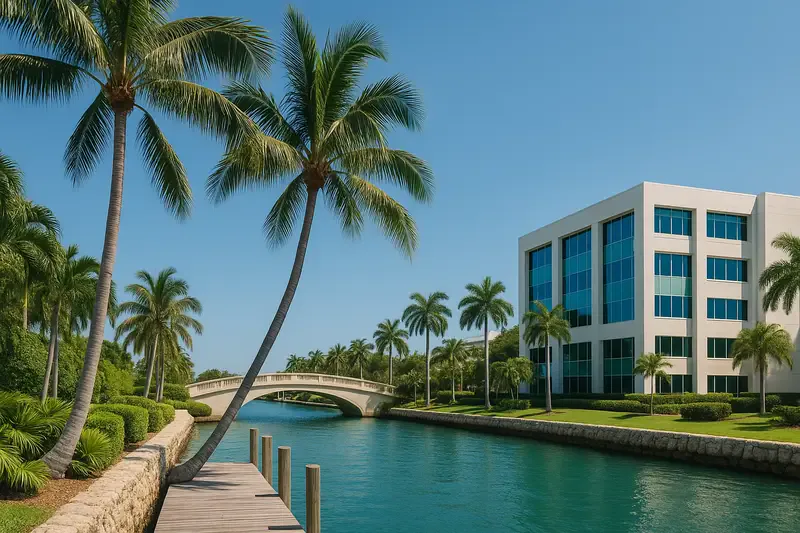
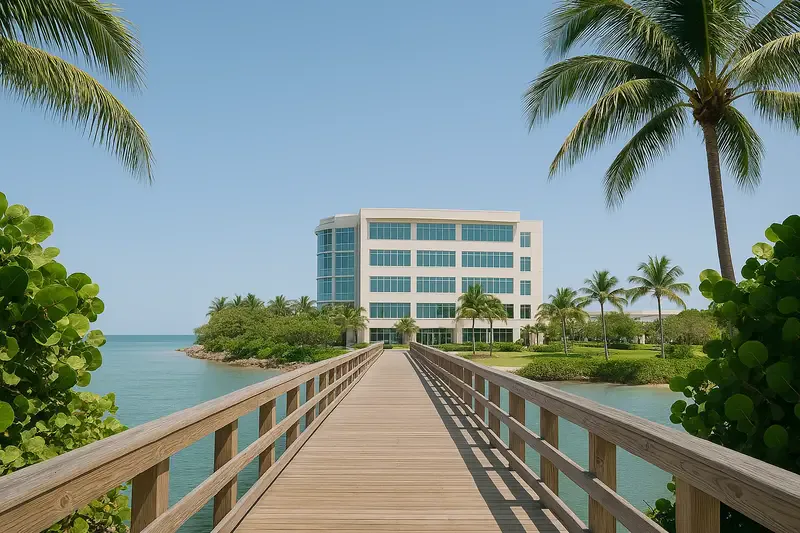
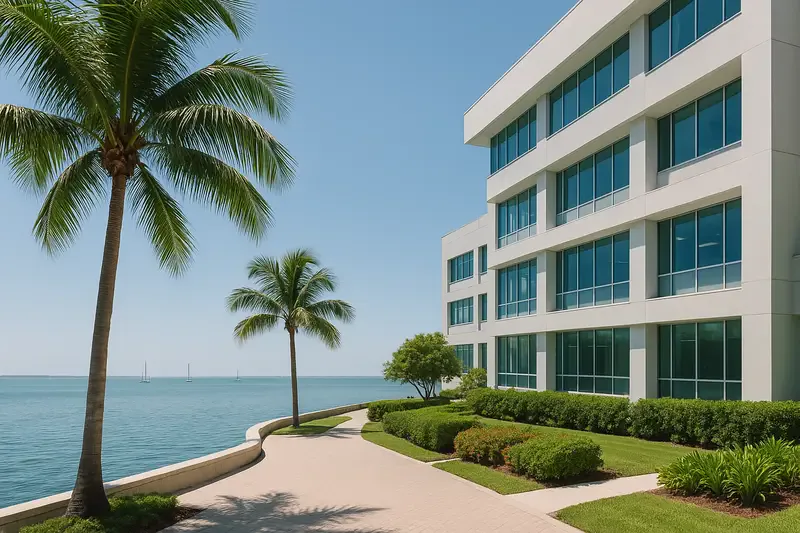
RECO Health's Delray Beach campus is a 50-minute drive up I-95 from Hollywood — close enough to run the six-week TMS protocol without relocating, far enough to separate treatment from the routines tied to active illness. In-house psychiatry handles the prior authorization, the motor threshold mapping, and the full 36-session course, with iTBS available for clients whose schedules cannot accommodate a 40-minute chair time. Clients pairing TMS with PHP or IOP can add on-site sober living for the duration of the acute phase.
The drive from Hollywood to RECO Health’s Delray Beach campus is 35 miles up I-95 — about 50 minutes outside rush hour, closer to an hour when southern Palm Beach and Broward traffic stacks up. For a course of TMS, that logistics question matters: repetitive Transcranial Magnetic Stimulation is a six-week outpatient protocol, five days a week, and the shape of the daily commute determines whether treatment holds together. Most Hollywood clients either build the round-trip into a fixed early-morning slot or, when combining TMS with PHP-level psychiatric care, take a room in on-site sober living for the duration of the acute phase.
Who is a candidate for rTMS
The insurance-covered indication for rTMS is major depressive disorder with documented failure of at least two adequate antidepressant trials — adequate dose, adequate duration (typically six to eight weeks at therapeutic dose), and documented adherence. A pattern that shows up repeatedly in referral notes: an SSRI such as sertraline or escitalopram, followed by an SNRI such as venlafaxine or duloxetine, sometimes with a bupropion augmentation attempt, and a PHQ-9 that has not moved below 15 across those trials. RECO’s psychiatry team documents the treatment history in a form the payer will accept and handles the prior authorization before scheduling the mapping session.
Clinical candidacy is a separate question from insurance candidacy. Screening rules out implanted metallic devices near the head (cochlear implants, deep brain stimulators, certain aneurysm clips), a prior seizure disorder or active seizure risk, and substance use severe enough to destabilize the treatment window. For clients whose presentation includes an active alcohol use disorder, TMS is generally sequenced after medical detox with CIWA-guided withdrawal management and stabilization on naltrexone or acamprosate. Comorbid OCD is treated on the deep TMS (Brainsway) platform under a separate FDA clearance, with YBOCS as the primary tracking scale.
Full program details are available on RECO Health’s TMS Therapy service page.
The 36-session protocol and what it actually looks like
Session one is motor threshold mapping. The technician determines the minimum stimulation intensity that reliably evokes a visible thumb twitch (the abductor pollicis brevis response), then sets treatment intensity at 120% of that motor threshold. This calibration is repeated periodically through the course. The standard rTMS protocol delivers roughly 3,000 pulses per session at 10 Hz over the left dorsolateral prefrontal cortex.
Sessions two through thirty are daily Monday through Friday for six weeks — 20 to 40 minutes in the chair depending on the exact coil pattern. The final six sessions are a taper: three per week for two weeks, then two, then one. Clients drive themselves home, return to work or family responsibilities the same day, and rarely need to modify their schedule beyond the appointment window itself. Mild scalp discomfort and a low-grade tension headache in the first week are the most common side effects; both typically resolve as the scalp adapts. Seizure risk on the standard 10 Hz protocol runs below one event per 30,000 sessions.
Progress is tracked with a PHQ-9 at baseline and every two to four weeks through the course, with a GAD-7 running alongside when anxiety is a prominent feature and a YBOCS on the deep TMS OCD pathway.
Response, remission, and the second-course question
Published response rates for rTMS in treatment-resistant depression run 40 to 60% depending on protocol definition and patient population; remission rates run 25 to 40%. In practice, response typically emerges between session 15 and session 25 — often a family member notices it before the client does — with continued gains through the taper and for several weeks after the last session.
Non-responders at sessions 20 to 25 are re-evaluated rather than pushed through the full 36 on autopilot. Sometimes the coil position warrants adjustment based on a repeat motor threshold. Sometimes the case is switched to an intermittent theta burst (iTBS) protocol, or to a bilateral protocol targeting both DLPFC. Sometimes the clinical picture points toward the ketamine or intranasal esketamine (Spravato) pathway instead, particularly when suicidal ideation is prominent and a six-week timeline is not clinically appropriate. Augmentation with lithium, aripiprazole, or low-dose quetiapine is considered where the case remains refractory beyond TMS alone.
Responders who later relapse are candidates for a second full course, typically 12 to 18 months after the first, and second courses respond at rates similar to the first.
iTBS and the shorter-session option
Intermittent Theta Burst Stimulation is an FDA-cleared alternative rTMS protocol that delivers equivalent antidepressant efficacy in a roughly three-minute session rather than a 20 to 40-minute session — non-inferiority established by the THREE-D trial published in The Lancet in 2018. For a Hollywood client whose work schedule cannot accommodate a 45-minute treatment window on top of the round-trip commute, iTBS makes daily treatment feasible without compromising the evidence base.
The 36-session structure remains the same. What changes is chair time: a full course of iTBS runs closer to 15 to 20 minutes in-and-out including setup, which for a client driving up from Emerald Hills or Hollywood Lakes turns a three-hour daily block into something under 90 minutes door-to-door. Insurance coverage for iTBS is not universal — most commercial plans reimburse it at parity with standard rTMS, but the psychiatry team confirms coverage in writing before enrollment.
What to expect on your first visit from Hollywood
The first visit is a psychiatric evaluation, not a treatment session. A RECO psychiatrist reviews the depression history in detail, confirms which prior medication trials meet the payer’s “adequate” definition, administers PHQ-9 and GAD-7 baselines (and ASRS or YBOCS where indicated), screens for the contraindications listed above, and orders any labs needed. This visit typically takes 60 to 90 minutes.
Motor threshold mapping is scheduled as a separate visit, usually within the following week once prior authorization is confirmed. Clients coming from Hollywood Beach, Emerald Hills, Hollywood Lakes, Hollywood Hills, or Oakwood take I-95 north to the Atlantic Avenue or Linton Boulevard exits; the campus is a short drive east of the interstate. Clients pairing TMS with partial hospitalization (PHP) or intensive outpatient (IOP) programming — often built around CBT, DBT skills groups, EMDR for trauma histories, and MI-based relapse prevention — frequently use RECO’s on-site sober living for the duration of treatment rather than commuting daily during the acute phase.
Insurance and admissions from Hollywood
RECO Health is in-network with Florida Blue, Aetna, Cigna, UnitedHealthcare, Humana, and Blue Cross Blue Shield plans commonly held in Broward and Palm Beach counties. Prior authorization for rTMS is standard once two adequate antidepressant trials are documented; admissions handles the medical necessity letter and the CPT coding before the first treatment session.
For clients who are close to but not quite at the two-trial threshold — for example, one adequate SSRI trial and one truncated SNRI trial — the psychiatry team will often complete a documented adequate trial as part of the workup, both to satisfy the payer and because the trial itself sometimes produces enough response to defer TMS. Out-of-pocket exposure is estimated in writing before the first session so the financial picture is fixed before session one, not discovered midway through the taper.
Serving residents of: Hollywood Beach, Emerald Hills, Hollywood Lakes, Hollywood Hills, Oakwood.
If it's any of these, we can help.
From Hollywood callers, most asked.
Does insurance cover TMS therapy at RECO Health for Hollywood clients?
How long is a full course of TMS?
What happens on the first visit from Hollywood?
How does rTMS actually work?
How do I get to RECO Health from Hollywood?
Can family be involved, and how is privacy handled?
Other hollywood-area communities we serve.
Confidential. No commitment.
Tell us a little and a real human from admissions will call you back. We verify insurance benefits within minutes and tell you honestly whether RECO Health is the right fit — including if we should refer you elsewhere.