
TMS therapy for Coral Springs — FDA-cleared TRD care, 35 minutes from home.
A specialist outpatient program for clients in Coral Springs. PHP, IOP, in-house psychiatry, sober-living network, family programming. Same admissions team, 24/7.
Start the conversation Or call directly — (561) 464-4077Local options exist. This is the clinical specialist.
For Coral Springs and Parkland families, RECO Health's Delray Beach campus is a 35-minute drive east on the Sawgrass Expressway that opens access to FDA-cleared rTMS delivered by fellowship-trained psychiatry — not a stand-alone TMS storefront. The full 36-session 10 Hz protocol, iTBS where schedules require it, and in-house pivots to ketamine or medication augmentation for non-responders are handled without a referral out. In-network with Florida Blue, Aetna, Cigna, UnitedHealthcare, Humana, and most BCBS plans.
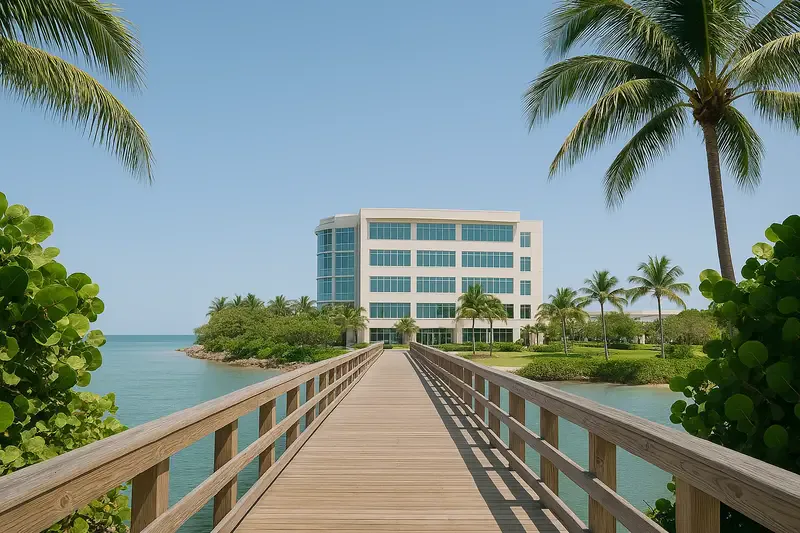
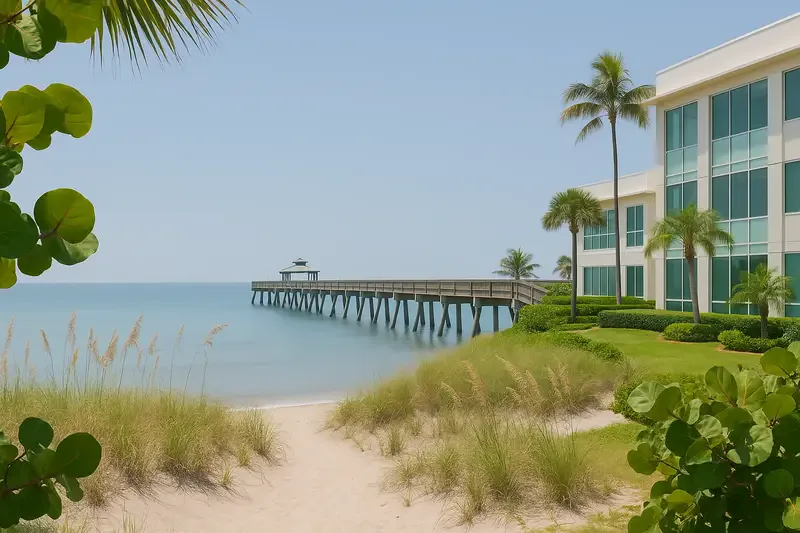
Coral Springs sits 25 miles inland from RECO Health’s Delray Beach campus — a 35-minute drive east on the Sawgrass Expressway to Florida’s Turnpike, then Atlantic Avenue to the coast. For adults in Eagle Trace, Hidden Hammocks, Parkland Isles, Cypress Run, and Heron Bay whose major depression has not responded to two or more antidepressant trials, that drive opens access to something Coral Springs does not offer at the same depth: FDA-cleared repetitive Transcranial Magnetic Stimulation delivered by a fellowship-trained psychiatry team inside a full continuum of addiction and mental-health care. No sedation, no cognitive recovery period, same-day return to work.
Who is a candidate for rTMS
The insurance-covered indication for TMS therapy is major depressive disorder with documented failure of at least two adequate antidepressant trials. “Adequate” is a specific standard: therapeutic dose — sertraline at 100-200 mg, escitalopram at 20 mg, venlafaxine XR at 225-300 mg, bupropion XL at 300-450 mg — held for at least six weeks with documented adherence. PHQ-9 scores at intake and at the endpoint of each prior trial anchor the medical-necessity file. Patients arriving from Coral Springs with clean pharmacy records and prior prescriber notes typically clear prior authorization within five to seven business days.
Clinical candidacy also requires screening for contraindications. Ferromagnetic implants within roughly 30 cm of the coil — cochlear implants, aneurysm clips, deep brain stimulators, cardiac pacemakers with cranial leads — are absolute exclusions. A history of unprovoked seizure, active alcohol or benzodiazepine withdrawal, or an unstable eating disorder shifts the risk calculus and usually reroutes the case into stabilization first. RECO’s psychiatry team, not a technician, makes the candidacy call.
Bipolar depression, comorbid OCD (which has a separate FDA clearance on the Deep TMS platform using the H7 coil over the medial prefrontal and anterior cingulate cortex), and treatment-resistant anxiety are handled case-by-case. The intake evaluation uses PHQ-9 for depression severity, GAD-7 for anxiety, YBOCS where OCD is on the differential, and ASRS when adult ADHD needs to be ruled out.
The 36-session protocol and what it actually looks like
Session one is motor threshold mapping. The psychiatrist positions the figure-8 coil over the primary motor cortex and increments pulse intensity until at least five of ten pulses reliably evoke a visible twitch in the contralateral abductor pollicis brevis. That intensity is the resting motor threshold. Treatment intensity is then set at 120% of that value, and the target — the left dorsolateral prefrontal cortex — is localized by the Beam F3 method or by neuronavigation.
Sessions two through thirty run Monday through Friday. The standard 10 Hz protocol delivers 3,000 pulses per session in four-second trains separated by 26-second inter-train intervals — roughly 37 minutes in the chair. The final six sessions are a taper: three the first week, two the second, one the third. Patients drive themselves in from Coral Springs, complete the session, and drive home. Mild scalp discomfort and a low-grade tension-type headache in week one are the most common side effects; both typically resolve without intervention. The rare seizure risk with FDA-cleared parameters is under 0.1% per treatment course.
Response, remission, and the second-course question
Published response rates for rTMS in treatment-resistant depression run 40-60% depending on protocol and outcome definition; sustained remission rates run 25-40%. Response is defined as a 50% or greater reduction in PHQ-9 or Montgomery-Åsberg Depression Rating Scale score; remission is a PHQ-9 under 5. Clinical response typically emerges between sessions 15 and 25, with continued gains through the taper. Patients and families are counseled to expect nothing in week one — the perception that “nothing is happening” through the first ten sessions is common and does not predict outcome.
Patients who are non-responders at session 20-25 are formally re-evaluated. Sometimes coil position needs adjustment — Beam F3 targeting can drift more than a centimeter from the individualized DLPFC location, and neuronavigation-corrected placement rescues a subset of cases. Sometimes a switch to intermittent theta burst (iTBS) is warranted. Sometimes the presentation looks less like unipolar TRD and more like bipolar-spectrum illness or a case that belongs on the ketamine or esketamine pathway, or on an augmentation strategy with aripiprazole, quetiapine, or lithium. RECO’s in-house psychiatry offers each of those pivots without a referral out.
Responders who later relapse — typically 6 to 18 months post-course — are candidates for a second full course. Data on maintenance TMS (one session weekly or monthly) is growing but thinner than the acute-course evidence base; coverage for maintenance is confirmed with the carrier before scheduling.
iTBS and the shorter-session option
Intermittent Theta Burst Stimulation is an FDA-cleared alternative rTMS protocol that delivers three-pulse 50 Hz bursts at 5 Hz — 600 pulses total in about three minutes. The THREE-D trial (2018) demonstrated non-inferiority to standard 10 Hz rTMS at six weeks. For a Coral Springs professional who cannot block 45 minutes plus drive time daily, iTBS makes the six-week protocol feasible: gate-to-gate under 30 minutes on-site.
Not every commercial plan reimburses iTBS at the same rate as standard rTMS, and some carriers still require step therapy through 10 Hz first. RECO’s admissions team confirms coverage in writing before enrollment and, where step therapy is required, documents the clinical rationale for a peer-to-peer appeal.
What the first visit looks like from Coral Springs
The initial psychiatric evaluation runs 60 to 90 minutes. The psychiatrist reviews the antidepressant trial history, current medications, substance-use screening (AUDIT-C, DAST-10), and prior psychotherapy exposure — CBT, DBT, EMDR, ACT, motivational interviewing. Standardized instruments (PHQ-9, GAD-7, and YBOCS or ASRS where indicated) anchor severity.
If candidacy is confirmed, prior authorization is initiated the same day. Motor threshold mapping is scheduled once authorization returns. Continuing antidepressants, ongoing therapy, and outside prescribers are coordinated with, not disrupted — TMS is delivered adjunctively, not as a replacement. For patients also managing co-occurring alcohol or opioid use disorders, RECO’s outpatient program can integrate naltrexone, acamprosate, or buprenorphine management alongside the TMS course, with CIWA- or COWS-guided stabilization completed before treatment begins.
Insurance and admissions from Coral Springs
RECO Health is in-network with Florida Blue, Aetna, Cigna, UnitedHealthcare, Humana, and most BCBS plans for rTMS delivered under the FDA-cleared indication for treatment-resistant depression. In-network out-of-pocket exposure is typically limited to the plan’s mental-health deductible and coinsurance across the full 36-session course. Self-pay pricing is quoted on request. The admissions team pulls pharmacy records and prior prescriber notes on the patient’s behalf and handles the peer-to-peer appeal if a carrier initially denies.
Serving residents of: Eagle Trace, Hidden Hammocks, Parkland Isles, Cypress Run, Heron Bay.
If it's any of these, we can help.
From Coral Springs callers, most asked.
Does insurance cover TMS therapy for Coral Springs patients at RECO Health?
How long does the full TMS course take, and how does it fit a working schedule?
What happens at the first visit before treatment begins?
How does TMS actually work, and what does a treatment session feel like?
How do I get to RECO Health from Coral Springs?
Can family members be involved, and how is confidentiality handled?
Other coral springs-area communities we serve.

Confidential. No commitment.
Tell us a little and a real human from admissions will call you back. We verify insurance benefits within minutes and tell you honestly whether RECO Health is the right fit — including if we should refer you elsewhere.